
Positive Self-Talk Worksheet for Kids
What we say to ourselves about ourselves in daily life has a huge impact on our thoughts, our lives, and our well-being! Working through negative thoughts and cultivating positive self – talk skills can raise our self-esteem and help us live a better life.
Negative self talk makes us feel discouraged, but with the variety of exercises in the digital format below, you’ll have the tools to begin shifting that mindset. Both you and your child can benefit from learning how to manage and reframe your thoughts. Download the worksheet below — it’s a great place to start!
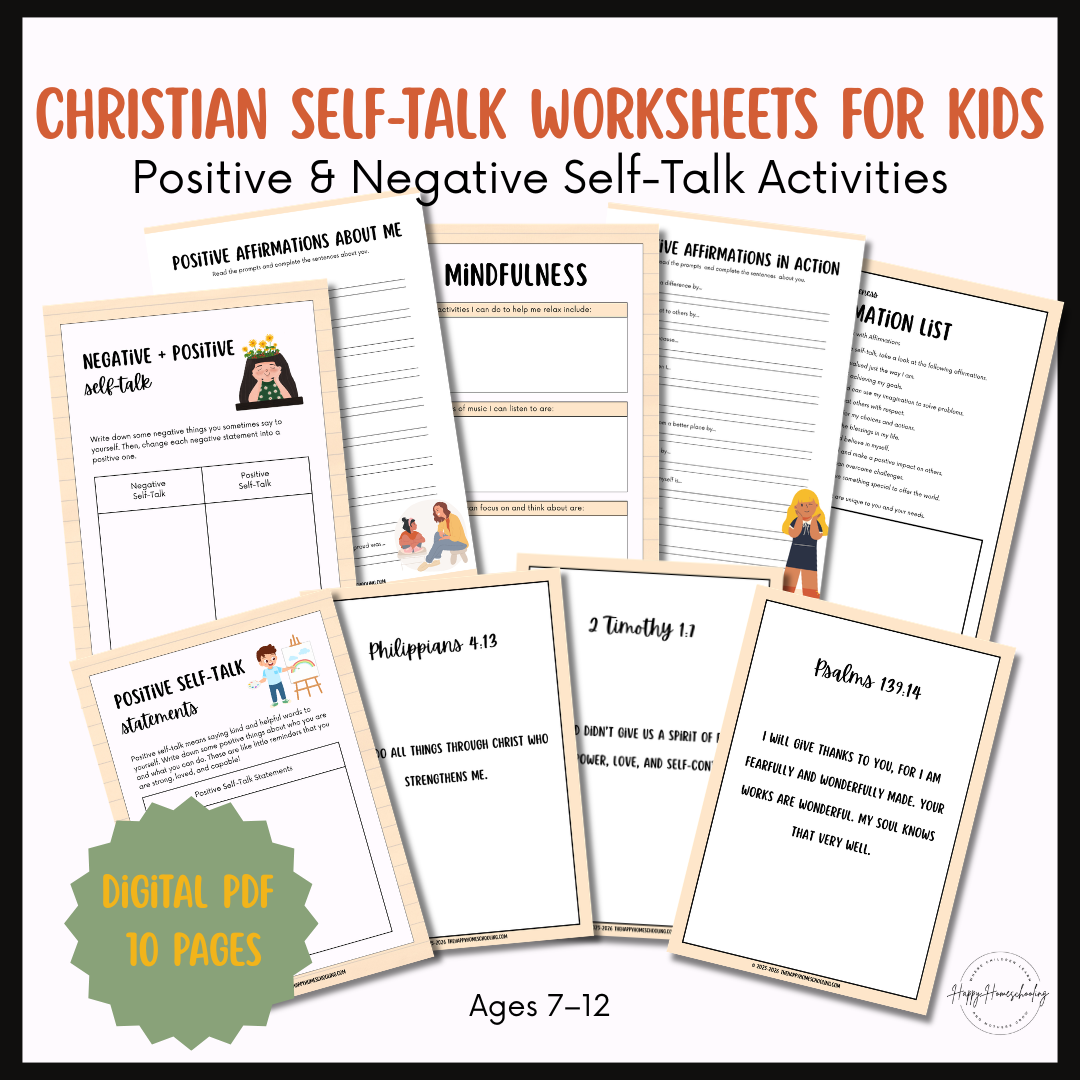
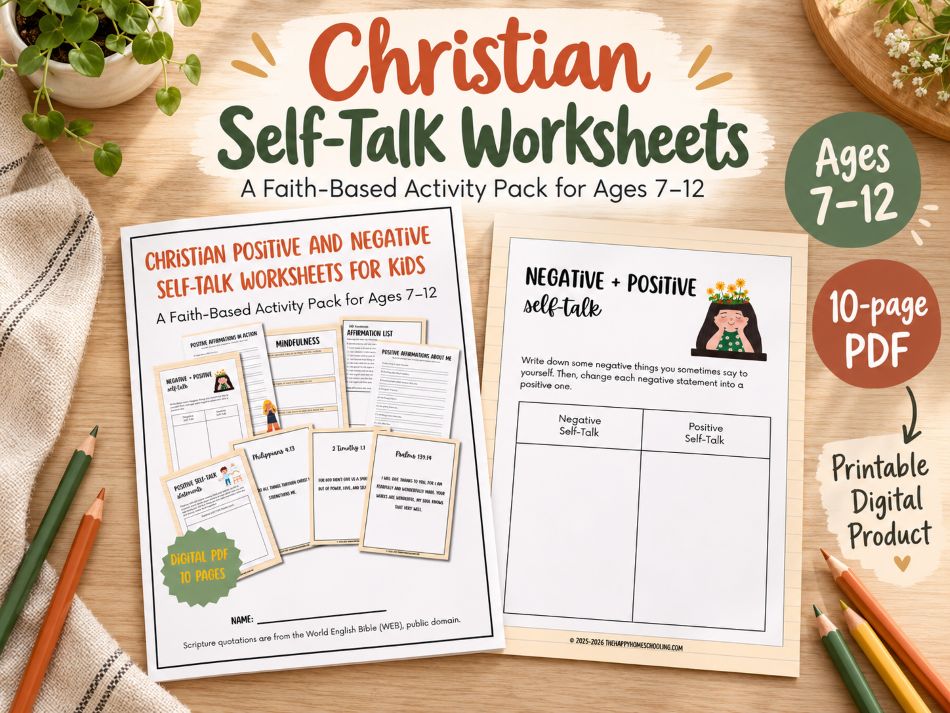
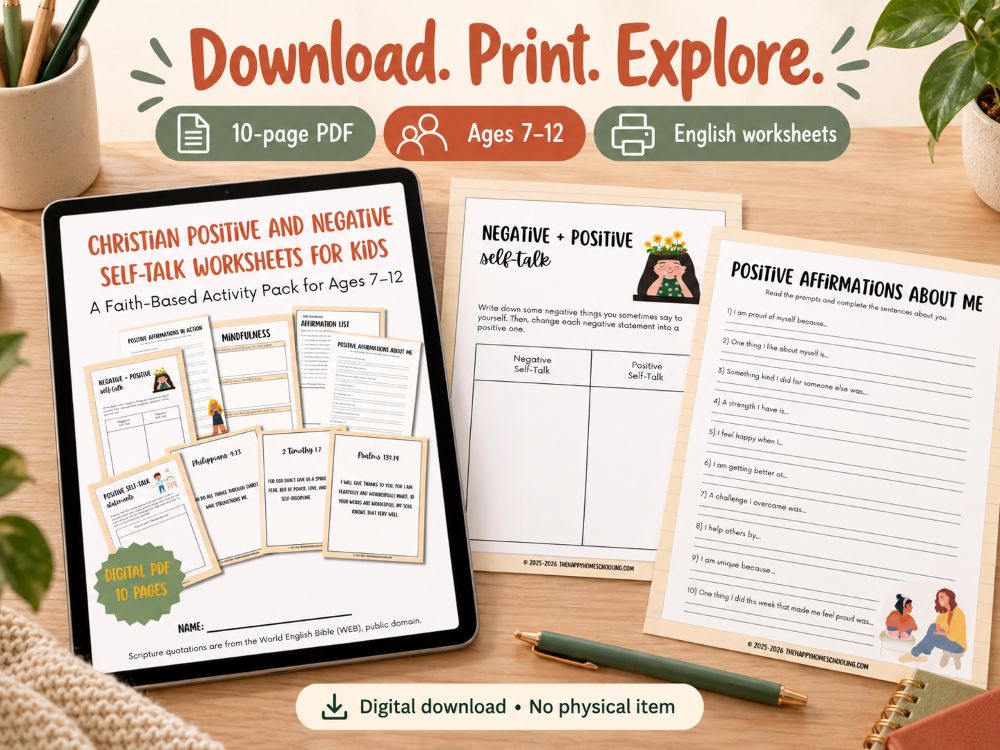
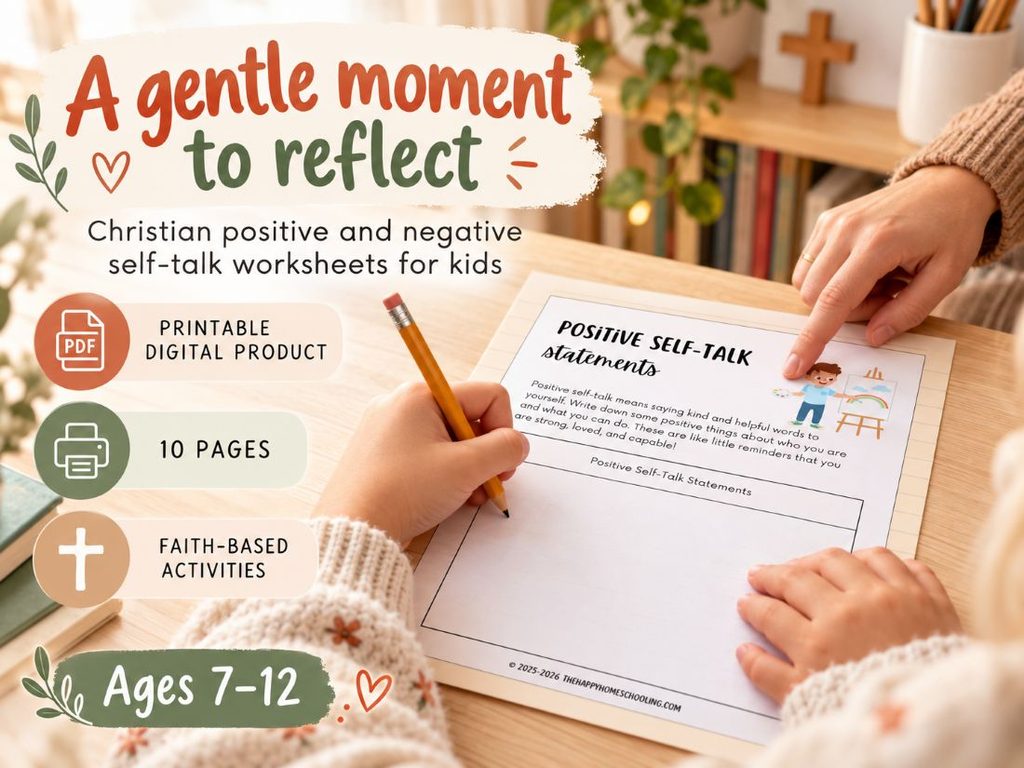
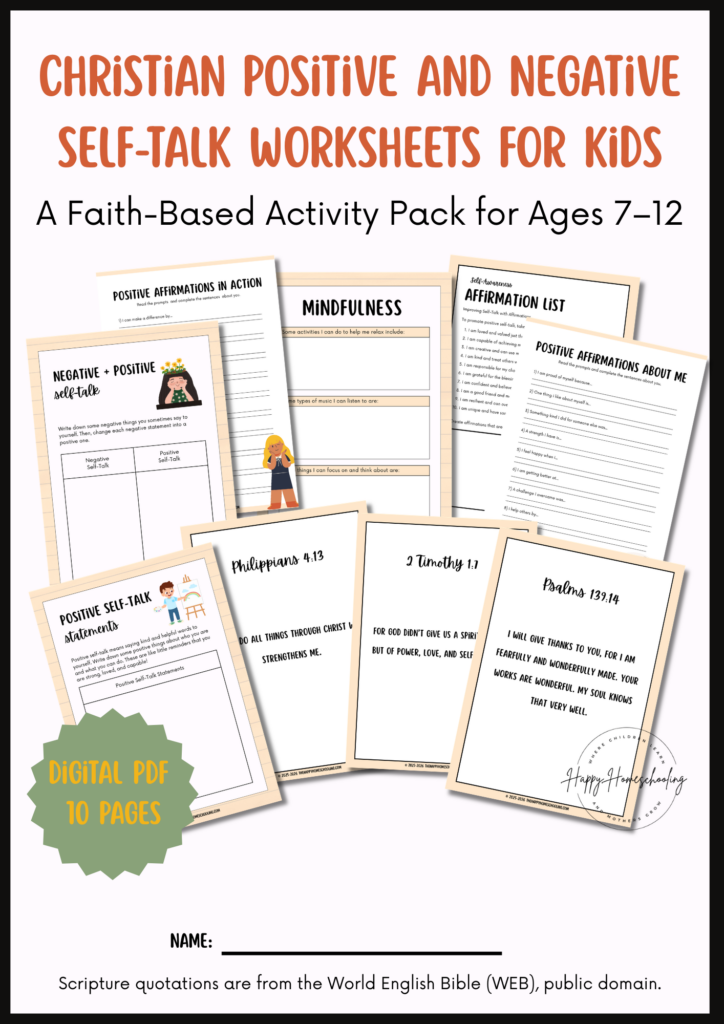
Help your child recognize negative self-talk and replace it with encouraging, Bible-based thoughts. This 10-page printable pack includes six worksheets and three Scripture posters for children ages 7–12.
Let me just state that I am not a therapist. I am only a mom to four children who wants to share what I have learned and the benefits of positive self-talk. My hope is that someone will benefit from it — and if that is only one single person, I would feel that it was worthwhile writing this post.
Personal growth does not come automatically; it needs constant maintenance. That’s why I want to share how you, too, can cultivate this important skill and experience the benefits of positive self-talk in your life!
What’s Included in the Printable Pack
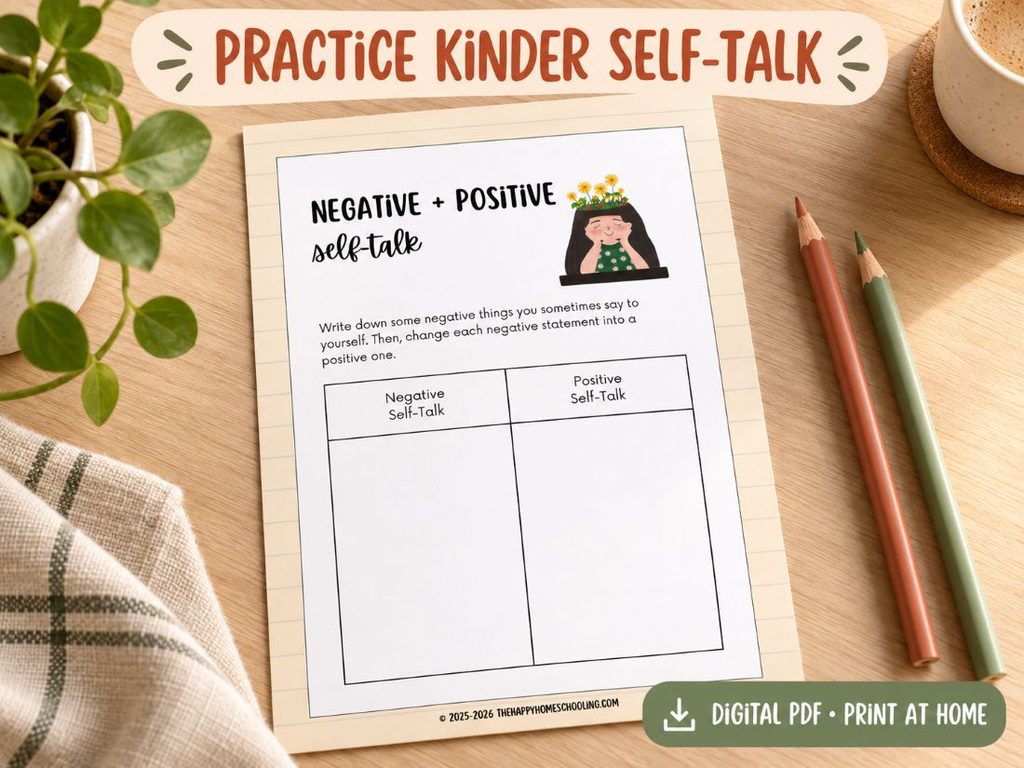
- Negative vs. Positive Self-Talk Worksheets
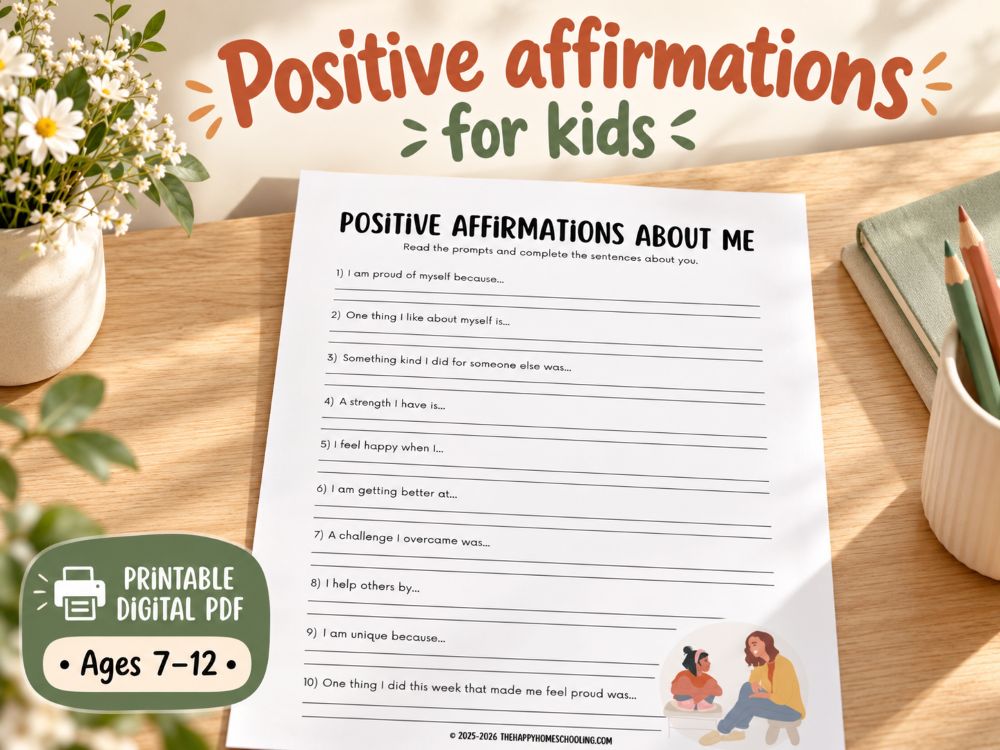
- Affirmation Worksheets
- Mindfulness exercises
- Positive self – talk phrases
- Bible-based affirmations
My Story – What Has Helped Me
A few years ago, I had the opportunity to be part of group coaching calls online with a life coach who helped me realize what was really going on inside my brain. This course gave me the tools to become more aware of what I was thinking and why. It also helped me fight those negative thoughts.
I have also listened to several coaching podcasts over the years that have helped me in many ways. There is so much we can learn from other coaches, and if you have the capacity to get a personal life coach, it will surely help you lead a better and more focused life.
I know how negative thoughts can impact your life and make it miserable. On the other hand, I have also experienced how positive thoughts — about yourself, life, and others — can lead to a happier and more energized life.
Journalize Your Thoughts – My Breakthrough
When I started journaling my thoughts—writing them down on a piece of paper—it opened my eyes to what was truly going on inside my mind. Because of this simple practice, I’ve been able to better understand and detect negative self-talk patterns, and gain a deeper awareness of my inner dialogue.
Writing down your thoughts is like holding up a magical mirror that reflects everything with crystal clarity. You can easily see what’s going on, and soon you’ll begin to recognize which thoughts are true—and which are not.
In other words, journaling your thoughts is a powerful tool you can use to analyze your thinking. It brings your internal dialogue into the light. But I want to emphasize this: if you write down negative thoughts, do not dwell on them too long. Instead, confront them with truth.
The positive self-talk worksheets below will surely help you do just that! Practicing positive self-talk statements on a daily basis is incredibly powerful. The benefits of engaging in this kind of work will lead to real and lasting positive changes in your life.
Writing Short Positive Self-Talk Phrases
Besides analyzing your thoughts in a journal, it’s also incredibly effective to write down the positive things about yourself and your achievements. This exercise is so beneficial that I just had to write a post about it — haha!
My hope, of course, is that you and your children (even kindergarten students!) can begin to apply this simple act of self-love by using the resource you can download below.
If you’re a Christian, you already have the perfect resource: the Bible. Using Bible verses to lift yourself up and encourage your heart can give you energy and God-given confidence. There are so many powerful verses to draw from. The key is that you must apply them.
That means:
- Find them,
- Use them — whether by writing them down or saying them out loud,
- And most importantly, understand and memorize them so they truly take root in your heart.
Start Early with Developing Positive Self-Talk Skills
Kids today need to protect their mental health and make it a priority. We can’t truly imagine all that they face each day. Positive thinking doesn’t come automatically. Some people may naturally lean toward it, but for most of us, I think, it’s something we have to work on.
Daily mental practice, along with using the negative self-talk worksheet you can access below, will help children focus on the good in themselves and build healthy self-esteem. The first step is simple: get a journal or download the worksheet below, and help your child incorporate this practice into their daily routine.
When your thoughts change, everything changes — your behavior, how you interact with others, how you speak, work, and even how you think. This positive shift will also happen in your child. They will become more confident and energized.
If your child is very young — for example, in kindergarten — you can start by writing down positive affirmations about them, then discuss those together. Help them learn how to say kind, empowering things about themselves and what they are capable of. You can also include Christ-centered affirmations, which I highly recommend.
Practicing positive self-talk with your child can have a powerful, lasting impact. It will help them see themselves as someone who is capable of success. As I mentioned earlier, you may begin to notice changes in their behavior, emotions, and even appearance — they may become more peaceful, stable, and joyful.
Helping your child start life with a growth mindset gives them a stronger foundation for long-term success. Don’t wait — download the printable below and start today. It’s also a fun and meaningful way to connect with your child and build a deeper dialogue.
Before letting your child do these exercises independently, go through them together first. Children need to be shown how to approach mindfulness practices like this. You can also write a list of affirmations about your child to help guide and encourage them.
Note: The goal here is not to boast or develop pride — either in yourself or in your child. Quite the opposite: this is about developing gratitude for who we are in God and recognizing that nothing is too difficult for Him. We can grow in confidence, not in ourselves alone, but in the truth that we can do all things through Christ who strengthens us.
How to Work With and Fight Negative Thoughts Using Positive Self-Talk
Find a piece of paper and a pen, and start by writing down some of your thoughts. What kind of thoughts have you been struggling with during the day or over the past week? Write them down in short phrases. Then, leave some space beneath each phrase where you can write a statement that reframes the negative thought with something positive. It’s especially powerful to use Bible verses in the reframing process.
Next, list a few positive affirmations about yourself, along with things you are grateful for about who you are. Finally, make a simple action plan for what you can do when negative thoughts arise — such as deep breathing, taking a walk, journaling, or another calming activity.
A Positive Self-Talk Worksheet
A Positive Self-Talk Worksheet can help people recognize negative thoughts and replace them with encouraging, constructive ones. Here are some sections you might include:
1. Identify Negative Self-Talk
- Write down common negative thoughts you have about yourself.
- Example: “I always mess things up.”
2. Reframe the Negative Thoughts
- Convert each negative thought into a positive or more balanced one.
- Example: “I learn from my mistakes and keep improving.”
3. Write a List of Positive Affirmations
- List 5–10 positive affirmations to say daily.
- Example: “I am capable and strong.”
4. Practice Gratitude
- Write down 3 things you appreciate about yourself.
5. Make an Action Plan for Self-Encouragement
- What will you do when negative thoughts arise?
(e.g., deep breathing, journaling, saying affirmations)
As you begin using this worksheet below, you’ll get better at identifying your negative thought patterns and become more mindful of how you speak to yourself. Over time, it becomes easier to replace negative thoughts with encouraging, truthful ones that lift you up instead of tear you down.
Examples of Positive Self-Talk and How to Reframe Negative Thoughts
Another simple and powerful way to work with your inner critic is to list your negative thoughts and actively replace them with your own positive self-talk statements. This method is easy, effective, and can make a big difference in how you see yourself.
Negative: I am never going to make this happen in my life.
Positive: I will work toward growth and allow myself to dream.
Negative: I am not good enough.
Positive: I am good enough and strong.
Negative: I’m not attractive.
Positive: I bring something special to the world.
Negative: I’m just not smart like others.
Positive: I am proud of how far I’ve come.
Negative: I’ll never change.
Positive: I am capable of achieving my goals.
Negative: I’m not good enough.
Positive: I am doing my best, and that’s enough.
Negative: No one really likes me.
Positive: I learn from my mistakes and grow stronger.
Negative: I’m too lazy to succeed.
Positive: I have valuable talents and skills.
Now, make your own personalized statements and focus on the positive ones. Say them often — even out loud. Notice how you feel when you do this, or ask your child how it feels to speak valuable words about themselves.
This is a powerful tool that your child can carry with them throughout life. And you are the one helping them build it — giving them the gift of knowing how to challenge negative thinking. That gift can guide them from low self-esteem toward a stronger, healthier self-image.
Bible Texts on Positive Mindset and Self-Confidence
The Bible makes it clear that how we think impacts both our body and our health. Scripture tells us that a peaceful heart gives life to the body and a merry heart does good—like medicine. That’s good news, friends! Our physical health can improve when we reduce negative self-talk and replace it with life-giving, positive thoughts.
Read the Bible verses below for inspiration on how to speak life over your child—and yourself. You can also check out some of my previous posts, like Encouraging Bible Verses for Moms, Bible Scriptures on Stress, or Bible Verses About Appreciation and Gratitude.
If you want to grow in your faith and explore what it means to become a Proverbs 31 woman, take a look at my Proverbs 31 Blueprint Mini Course for Moms.
Proverbs 14:30 (NKJV)
A sound heart is life to the body, But envy is rottenness to the bones.
Proverbs 17:22
A merry heart does good, like medicine, But a broken spirit dries the bones.
Philippians 4:13 (NKJV)
I can do all things through Christ who strengthens me.
Psalms 139:13-14 (NKJV)
For You formed my inward parts; You covered me in my mother’s womb. I will praise You, for I am fearfully and wonderfully made; Marvelous are Your works, And that my soul knows very well.
II Timothy 1:7 (NKJV)
For God has not given us a spirit of fear, but of power and of love and of a sound mind.
Romans 8:37 (NKJV)
Yet in all these things we are more than conquerors through Him who loved us.
Ephesians 2:10 (NLT)
For we are God’s masterpiece. He has created us anew in Christ Jesus, so we can do the good things he planned for us long ago.
Isaiah 41:10 (NKJV)
Fear not, for I am with you; Be not dismayed, for I am your God. I will strengthen you, Yes, I will help you, I will uphold you with My righteous right hand.
Joshua 1:9 (NKJV)
Have I not commanded you? Be strong and of good courage; do not be afraid, nor be dismayed, for the Lord your God is with you wherever you go.
Psalms 42:5 (NKJV)
Why are you cast down, O my soul? And why are you disquieted within me? Hope in God, for I shall yet praise Him For the help of His countenance.
I Peter 5:7 (NKJV)
Casting all your care upon Him, for He cares for you.
Matthew 6:25 (NKJV)
Therefore I say to you, do not worry about your life, what you will eat or what you will drink; nor about your body, what you will put on. Is not life more than food and the body more than clothing?
Philippians 4:8 (NKJV)
Finally, brethren, whatever things are true, whatever things are noble, whatever things are just, whatever things are pure, whatever things are lovely, whatever things are of good report, if there is any virtue and if there is anything praiseworthy—meditate on these things.
Isaiah 26:3 (NKJV)
You will keep him in perfect peace, Whose mind is stayed on You, Because he trusts in You.
Psalms 100:4 (NKJV)
Enter into His gates with thanksgiving, And into His courts with praise. Be thankful to Him, and bless His name.
II Corinthians 12:9 (NKJV)
And He said to me, “My grace is sufficient for you, for My strength is made perfect in weakness.” Therefore most gladly I will rather boast in my infirmities, that the power of Christ may rest upon me.
Ephesians 3:12 (NIV)
In him and through faith in him we may approach God with freedom and confidence.
Hebrews 4:16 (NKJV)
Let us therefore come boldly to the throne of grace, that we may obtain mercy and find grace to help in time of need.
Hebrews 13:6 (NKJV)
So we may boldly say: “The Lord is my helper; I will not fear. What can man do to me?”
Isaiah 32:17 (NKJV)
The work of righteousness will be peace, And the effect of righteousness, quietness and assurance forever.
Isaiah 40:31 (NKJV)
But those who wait on the Lord Shall renew their strength; They shall mount up with wings like eagles, They shall run and not be weary, They shall walk and not faint.
Jeremiah 17:7 (NKJV)
Blessed is the man who trusts in the Lord, And whose hope is the Lord.
Nehemiah 6:16 (NKJV)
When all our enemies heard about this, all the surrounding nations were afraid and lost their self-confidence, because they realized that this work had been done with the help of our God.
Help your child recognize negative self-talk and replace it with encouraging, Bible-based thoughts. This 10-page printable pack includes six worksheets and three Scripture posters for children ages 7–12.
